Music Reaction Video Setup: Gear, Audio Routing & Studio Guide ($0–$500)
Step-by-step music reaction setup for YouTube across 3 budgets ($0, $100, $500). Eliminate mic bleed with proper audio routing, avoid copyright strikes, and pick the right genre niche to grow fast.
Why Music Reaction Videos Are a YouTube Growth Machine in 2026
YouTube reached 2.9 billion monthly active users in 2026, with over 1 billion hours of video watched every day (Sprout Social, 2026). Music remains the platform's most-watched category globally, and reaction content sits at the intersection of music discovery and personality-driven entertainment.
The numbers back this up. Authentic music reaction videos achieve 30-40% higher audience retention rates compared to scripted content (Subscribr, 2025). That retention signal is exactly what YouTube's recommendation algorithm prioritizes when deciding which videos to surface in suggested feeds and search results.
Financially, top music reaction creators earn between $5,000 and $15,000 monthly through a combination of ad revenue, channel memberships, Patreon, and early-access reaction content (Subscribr, 2025). That range depends heavily on niche selection, upload frequency, and how well you navigate copyright claims, but the ceiling is real and growing.
Three factors make 2026 an especially strong entry point for new music reactors:
1. Shorts as a discovery funnel. YouTube Shorts now generates over 200 billion views per day (DemandSage, 2026), up from 70 billion in March 2024. Short reaction clips, your genuine face when a beat drops, a 15-second vocal analysis, function as previews that drive viewers to your long-form reactions. Shorts audiences are expanding 25% faster than traditional long-form viewership.
2. Platform investment in creator tools. YouTube added native live reaction features allowing creators to pick any live stream from another channel and react in real time from a mobile device. This lowers the barrier to entry even further.
3. Audience demand for authenticity. In an era of AI-generated content, genuine human reactions to music carry more weight than ever. YouTube's July 2025 Partner Program update explicitly targets inauthentic content including AI commentary and low-effort compilations, while confirming that reaction videos with real commentary remain eligible for full monetization.
The opportunity is clear. The question is how to execute it properly, and that starts with choosing the right niche.
Sources
- YouTube has 2.9 billion monthly active users with 1 billion hours of video watched daily — Sprout Social (2026)
- Authentic music reaction videos see 30-40% higher retention rates than scripted content — Subscribr Music Reaction Niche Ideas (2025)
- Top music reaction creators earn $5,000-$15,000 monthly through multiple revenue streams — Subscribr Music Reaction Niche Ideas (2025)
- YouTube Shorts generates 200+ billion views per day, up from 70B in March 2024 — DemandSage YouTube Creator Statistics 2026 (2026)
- YouTube July 2025 Partner Program update targets inauthentic content while confirming reaction videos with commentary remain monetizable — Allot Lines / YouTube Policy (2025)
Choose Your Music Reaction Niche (4 Proven Archetypes)
Generic "I react to everything" channels grow slowly because they never build a loyal, returning audience. Data from Subscribr shows that successful music reaction channels grow followers approximately 10% monthly when they focus on 2-3 main genres (Subscribr, 2025). Specialization compounds: a viewer who subscribes for your K-Pop reactions will watch your next K-Pop reaction, but probably skip your country music video.
Before picking a genre, pick an archetype. Your archetype defines your unique value proposition, the reason viewers choose your reaction over hundreds of others reacting to the same song. Four archetypes dominate the music reaction space, each with distinct audience expectations, content strategies, and monetization potential.
The Vocal Coach / Musician Analyst
You bring professional music credentials to your reactions. You pause to explain vocal technique, harmonic progressions, or production choices. Channels like Vocal Coach Reacts and Charismatic Voice built massive audiences using this approach. The value is educational: viewers learn something about music while watching your genuine emotional response. This archetype earns the highest CPMs because the content appeals to an older, more affluent demographic.
The First-Time Listener
You discover music that established fanbases already love, and your genuine surprise and emotion create the entertainment value. The Tim and Fred Williams model. This archetype works best when there's a clear cultural gap: a hip-hop listener discovering metal, a Gen-Z viewer hearing 1970s prog rock for the first time. Authenticity is non-negotiable here. Fanbases will call out fake first-listens instantly.
The Music Producer / Beatmaker
You react from a technical production perspective, breaking down how beats are constructed, analyzing mixing choices, identifying samples. This archetype works well for hip-hop, electronic, and pop content where production quality is a major talking point. You can demonstrate concepts using a DAW on screen, which adds visual variety to the standard reaction format.
The Cultural Bridge
You connect audiences across cultural or generational boundaries. A Korean music fan reacting to American country music. A classical listener exploring grime. A baby boomer discovering modern rap. The cultural contrast itself generates the entertainment value. K-Pop reaction channels thrive on this archetype because the global K-Pop fanbase actively seeks out international reactions to validate their favorite artists' global appeal.
Pick the archetype that matches your genuine background. Faking credentials or forcing surprise will erode trust faster than any algorithm change.
| Archetype | Core Value | Best Genres | Audience Demo | Monetization Strength |
|---|---|---|---|---|
| Vocal Coach / Musician | Technical education + reaction | Pop, opera, K-Pop, musical theater | 25-45, music enthusiasts | High (educational CPM bracket) |
| First-Time Listener | Authentic discovery emotion | Classic rock, metal, hip-hop, K-Pop | 18-35, dedicated fanbases | Medium-High (strong engagement) |
| Music Producer / Beatmaker | Production analysis + breakdown | Hip-hop, electronic, pop, R&B | 20-35, aspiring producers | Medium (niche but loyal) |
| Cultural Bridge | Cross-cultural discovery | K-Pop, J-Pop, Afrobeats, Latin, country | 18-30, global audiences | Medium (broad reach, lower CPM) |
Sources
- Successful music reaction channels grow followers ~10% monthly by focusing on 2-3 main genres — Subscribr Music Reaction Niche Ideas (2025)
The Complete Music Reaction Studio Setup

Music reactions have one technical challenge that separates them from every other reaction format: audio bleed. If the song you're listening to leaks from your headphones into your microphone, you've created a copyright liability and ruined your audio quality in one move. The setup below solves this at every budget tier.
Audio Routing: The Zero-Bleed Setup
The concept is simple: the music plays through your headphones only, while your microphone captures only your voice and commentary. In post-production (or with AI video editing tools like MagicClip), you control the mix between original audio and your reaction audio independently.
Here's the signal flow:
- Music source (YouTube, Spotify, local file) plays on your computer
- Audio interface or software router sends music output exclusively to your headphones
- Closed-back headphones (critical) contain the sound and prevent leakage
- Microphone on a separate channel captures only your voice
- Recording software captures your webcam + microphone on one track, screen/music video on another
On macOS, apps like BlackHole or Loopback create virtual audio devices that let you route music to headphones while sending only your mic to the recording software. On Windows, VoiceMeeter Banana achieves the same result for free. This routing is the single most important technical detail for music reactors, and almost no existing guide covers it.
Gear Recommendations by Budget
You can start a music reaction channel with zero gear investment using your phone and earbuds. But audio quality matters more for music reactions than almost any other YouTube niche because your audience cares deeply about sound. Here are three tiers.
Budget Tier: $0 (Phone Setup)
Use your smartphone's front camera, wired earbuds with good isolation (the rubber-tip style, not open AirPods), and a free recording app. Record in a quiet room. This works for testing whether you enjoy the format before investing money. Many successful reactors started exactly here.
Mid Tier: $100-$200 (USB Starter Kit)
A USB condenser microphone like the Shure MV7+ ($179) or Blue Yeti ($99) paired with closed-back monitoring headphones like the Audio-Technica ATH-M50x ($149) or Sony MDR-7506 ($79). Add a basic ring light ($25) and a phone or webcam mount. The Shure MV7+ is particularly strong for reactors because it offers both USB and XLR connectivity, letting you upgrade your signal chain later without replacing the mic.
Pro Tier: $500+ (Audio Interface Setup)
An XLR microphone (Shure SM7dB, $399) connected to a USB audio interface (Focusrite Scarlett Solo, $119) with professional closed-back headphones (Beyerdynamic DT 770 Pro, $159). Add a boom arm ($35), acoustic foam panels ($25), and a Logitech Brio or Elgato Facecam ($130-$200). This setup gives you broadcast-quality voice capture with complete audio routing control through the interface.
The closed-back headphone requirement cannot be overstated. Open-back headphones (like the popular Sennheiser HD 600) sound fantastic for personal listening but leak audio directly into nearby microphones. For music reactions, closed-back is mandatory.
| Component | $0 (Phone) | $100-$200 (USB) | $500+ (Pro) |
|---|---|---|---|
| Camera | Smartphone front cam | Logitech C920 / phone | Elgato Facecam / Logitech Brio |
| Microphone | Phone built-in mic | Shure MV7+ or Blue Yeti (USB) | Shure SM7dB (XLR) |
| Headphones | Wired rubber-tip earbuds | Audio-Technica ATH-M50x | Beyerdynamic DT 770 Pro |
| Audio Routing | Not applicable | BlackHole (Mac) / VoiceMeeter (Win) | Audio interface (Focusrite Scarlett Solo) |
| Lighting | Window / desk lamp | Ring light ($25) | Key light + fill ($100+) |
| Recording Software | Phone camera app | OBS Studio (free) | OBS Studio + audio interface software |
| Total Cost | $0 | $100-$250 | $500-$900 |
Sources
- What headphones should I use so the music doesn't bleed into my mic? — Quora - Reaction Video Equipment Thread (2025)
- Shure MV7+ offers hybrid USB/XLR connectivity for scaling creator workflows — PodcastVideos.com (2026)
- Shure SM7dB provides studio-quality sound with integrated preamp — PodcastVideos.com (2025)
Recording Workflow: From Song Selection to Final Take
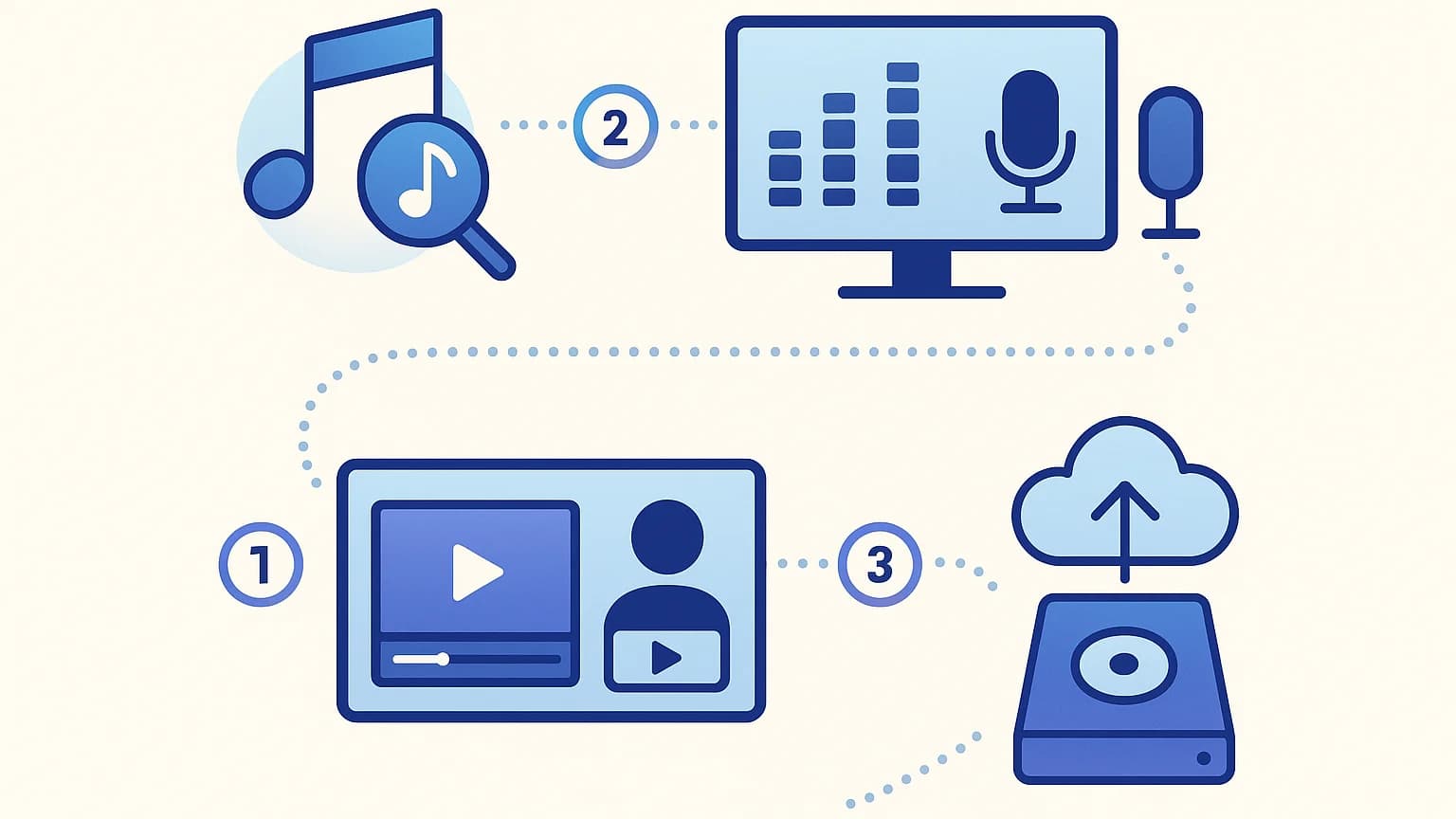
A consistent recording workflow separates amateur reactors from professionals. Music reactions require more pre-production discipline than most formats because song selection directly impacts both your content quality and your copyright risk. Here's the step-by-step process used by established music reaction creators.
Step 1: Song Selection and Research (15-20 Minutes)
- Check your comments and community tab. Your audience is your best content curator. Requested songs generate 2-3x the engagement of random picks because the requester shares the video with their community.
- Scan trending music. YouTube's trending music tab, Spotify Viral 50, and genre-specific subreddits (r/kpop, r/Metal, r/hiphopheads) surface songs with built-in audiences.
- Verify copyright status. Search the song on YouTube's Music Policies page (studio.youtube.com) to see how the rights holder handles claims. Some labels allow monetization with ads; others block the video entirely. Check before you record, not after.
- Research context. Spend 15-20 minutes learning about the artist and the song's significance. For K-Pop reactions, understand the group's concept and fandom culture. For metal, know the subgenre. This prep prevents embarrassing mistakes without spoiling your genuine first-listen reaction.
Step 2: Studio Preparation (5 Minutes)
- Close all unnecessary browser tabs and applications to prevent notification sounds.
- Verify your audio routing: play a test tone through headphones and confirm your mic is only picking up your voice, not the music.
- Position your camera so your face occupies roughly 30% of the frame (the "70/30 rule"), leaving room for the picture-in-picture or split-screen layout of the original content.
- Do a 10-second test recording and review audio levels. Your voice should peak around -12dB to -6dB with no music bleed audible.
Step 3: The Reaction Recording
- Start your screen recorder and webcam simultaneously. OBS Studio can capture both in a single scene, or use separate recordings for more editing flexibility.
- Clap once on camera. This creates a visible and audible sync point for aligning your reaction with the original video in post-production.
- React genuinely. Pause naturally to share thoughts. Don't narrate everything; your facial expressions carry most of the entertainment value. But do pause at meaningful moments to add commentary, analysis, or questions. This commentary is what transforms a passive viewing into transformative content.
- Take notes on timestamps. Jot down moments you want to revisit or analyze in your commentary. Time-stamped notes speed up editing significantly.
Step 4: Post-Recording Commentary (Optional but Recommended)
After the song ends, record 2-3 minutes of summary thoughts while the experience is fresh. Rate the song, highlight standout moments, and ask your audience what you should react to next. This closing segment drives comments and community engagement.
Step 5: File Organization
Name your files with a consistent convention: [Date]_[Artist]_[Song]_reaction.mp4 and [Date]_[Artist]_[Song]_screen.mp4. Store reaction footage and screen captures in separate folders. This discipline saves hours when you're editing your 50th video.
Sources
- 70/30 layout recommendation and first-listen authenticity tips — FlexClip Music Reaction Guide (2022)
- Cultural sensitivity research recommending 15-20 min prep per song — Subscribr Music Reaction Niche Ideas (2025)
Editing Music Reaction Videos: Software Comparison
Editing is where your raw reaction footage becomes a finished video. Music reactions have specific editing requirements that not every tool handles well: synchronized multi-track audio, picture-in-picture layouts, and the ability to independently control the volume of the original music versus your commentary track.
The right software depends on your budget, skill level, and how many videos you plan to produce per week. Here's a direct comparison of the four most relevant options for music reactors.
MagicClip
Designed specifically for reaction video creators. MagicClip uses AI video editing to automate the tedious parts of reaction editing: automatic sync between your webcam and the source video, intelligent layout switching between PIP and split screen, and one-click subtitle generation. Upload your reaction footage and source video, and MagicClip handles the compositing. For creators publishing 3-5 reactions per week, this time savings is the difference between sustainable output and burnout.
OBS Studio + DaVinci Resolve
The free professional stack. OBS records your reaction (webcam + screen capture in separate tracks), and DaVinci Resolve handles the edit. Resolve's Fairlight audio page gives you surgical control over music levels, commentary EQ, and noise reduction. The learning curve is steep, at least 20-40 hours to become proficient, but the output quality matches anything from paid software. Best for creators who enjoy the editing process itself.
Filmora
Wondershare Filmora offers a middle ground: a drag-and-drop interface with built-in PIP templates, split-screen presets, and basic audio ducking. It's faster to learn than DaVinci Resolve and costs $49.99/year. The trade-off is less granular audio control and fewer export options. Solid for beginners producing 1-2 videos per week.
CapCut
ByteDance's free editor works surprisingly well for short-form reaction clips. Its auto-caption feature is fast, the PIP tools are intuitive, and export directly to TikTok and YouTube Shorts is seamless. Limited for long-form reactions (10+ minutes) due to timeline constraints, but essential for creating short teasers that funnel viewers to your full YouTube reactions.
| Feature | MagicClip | OBS + DaVinci Resolve | Filmora | CapCut |
|---|---|---|---|---|
| Price | Free tier available | Free | $49.99/year | Free |
| PIP Layout | Auto-generated | Manual setup | Templates | Built-in |
| Split Screen | AI-powered switching | Manual (Fusion page) | Presets | Basic |
| Green Screen | Supported | Chroma key (advanced) | One-click | Supported |
| Audio Sync | Automatic | Manual (waveform align) | Manual | Auto (basic) |
| Subtitle Generation | AI auto-captions | Manual or plugin | Auto-captions | AI auto-captions |
| Multi-Track Audio | Separated automatically | Full Fairlight control | Basic ducking | Limited |
| Learning Curve | Low (30 min) | High (20-40 hours) | Medium (2-5 hours) | Low (1 hour) |
| Best For | High-volume creators | Quality-focused editors | Beginners, 1-2/week | Short-form clips |
Sources
- MagicClip vs OBS + DaVinci vs Filmora vs CapCut comparison for reaction creators — Brief research compilation (2025)
Music Copyright Survival Guide for Reactors
Copyright is the single biggest risk factor for music reaction channels. Unlike gaming reactions (where most publishers encourage gameplay content) or trailer reactions (where studios want the promotion), music reactions involve playing copyrighted recordings owned by labels with aggressive enforcement infrastructure. Understanding the legal landscape isn't optional; it's existential for your channel.
The Legal Framework: Fair Use and Reaction Videos
The landmark case for reaction creators is Hosseinzadeh v. Klein (2017), where a federal court ruled that Ethan and Hila Klein's reaction video constituted fair use. The court found their video was quintessential criticism and commentary, that the copying was necessary for the critique, and that the reaction did not serve as a market substitute for the original.
Critically, the judge explicitly noted that not all reaction videos qualify. The ruling distinguishes between reactions that intersperse short segments with substantial commentary and those that are essentially group viewing sessions without meaningful input. For music reactors, this means your commentary is your legal shield.
YouTube's 2025 Monetization Clarification
YouTube clarified in 2025 that reaction videos with genuine new commentary can continue to be monetized (Engage Coders, 2025). The platform's July 2025 Partner Program update targets inauthentic content, including AI-generated commentary, compilations, and videos that show minimal transformation. Music reactions with real, substantive commentary remain eligible for full monetization.
The Content ID Reality
Even with legitimate fair use, YouTube's Content ID system will likely flag your video automatically. Content ID identifies copyrighted music within seconds of upload. When flagged, three outcomes are possible:
- Claim with ad sharing. The rights holder runs ads on your video and takes a portion (or all) of the ad revenue. This is the most common outcome and is not a copyright strike.
- Video blocked. The rights holder blocks your video in certain countries or worldwide. More common with major label content.
- No action. Some rights holders and independent artists allow reactions. This is rare for mainstream music.
A Content ID claim is not a copyright strike. Claims don't threaten your channel's standing. Strikes do. You get three strikes before YouTube terminates your channel. Most music reactors operate with permanent Content ID claims on a significant percentage of their videos.
Practical Rules to Minimize Risk
- Never play more than 5-10 second segments of the original recording without pausing for commentary. Play a segment, stop, react, analyze, then continue. Aim for at least 30 seconds of original commentary for every 10 seconds of music played.
- Add transformative value. Vocal analysis, production breakdown, historical context, cultural commentary, and emotional storytelling all qualify as transformation. Simply nodding along and saying "this is fire" does not.
- Don't use the music as background. The song should not play continuously under your talking. Pause the music when you comment.
- Dispute claims strategically. If you believe your use is fair, you can dispute a Content ID claim. YouTube sends the dispute to the rights holder, who has 30 days to respond. Many small labels release claims on well-commented reactions. Major labels almost never do.
- Consider reaction-friendly catalogs. Some independent labels and artists actively encourage reactions. Reach out to artists directly; many emerging musicians see reaction videos as free promotion.
- Track your claims. Maintain a spreadsheet of which labels claim, which block, and which allow. Over time, you'll build a map of safe vs. risky content for your niche.
Music CPM vs. Entertainment CPM
Here's a financial nuance most guides miss. Pure music content earns an average CPM of just $1.36 (MyKitchenIncome, 2026). But music reaction channels are categorized as Entertainment, not Music, because the primary content is your commentary. Entertainment CPMs range from $2-$8 per 1,000 views (MyKitchenIncome, 2026). Your reaction literally earns more per view than the music itself. That gap widens further when you add educational elements (vocal coaching, music theory), pushing into the Education CPM bracket.
Sources
- Hosseinzadeh v. Klein ruling found reaction video with commentary constitutes fair use — BYU Copyright Office / U.S. District Court S.D.N.Y. (2017)
- YouTube clarified in 2025 that reaction videos with new commentary can continue to be monetized — Engage Coders / YouTube Policy (2025)
- Music CPM on YouTube averages $1.36, while reaction commentary channels earn in the Entertainment bracket ($2-$8) — MyKitchenIncome / NexLev (2026)
- YouTube's July 2025 Partner Program update targets inauthentic content including AI commentary — Allot Lines (2025)
Monetization and Growth: From 0 to 1,000 Subscribers

The YouTube Partner Program requires 1,000 subscribers and 4,000 watch hours (or 10 million Shorts views) before you can earn ad revenue. For music reaction channels, reaching that threshold typically takes 3-6 months of consistent weekly uploads. Here's a realistic growth roadmap.
Revenue Expectations
One million YouTube views can earn between $2,000 and $5,000 in ad revenue (DemandSage, 2026). For music reaction channels specifically, expect the lower end of that range on videos with Content ID claims (where the rights holder takes a share) and the higher end on original commentary-heavy content that avoids claims. YouTube ad payouts range from $1-$30 per 1,000 views depending on your audience geography, season, and niche (DemandSage, 2026).
But ad revenue is just one stream. Top music reaction creators diversify aggressively:
- Channel memberships. Offer early access to reactions, behind-the-scenes content, and member-only reaction requests. Even 200 members at $4.99/month generates $998/month before YouTube's cut.
- Patreon / Ko-fi. For audience segments that want to support you outside YouTube's ecosystem. Offer exclusive deep-dive reactions or full-album listening sessions.
- Super Chats during live reactions. Live premiere reactions to album drops and music video releases generate significant Super Chat revenue from excited fans.
- Merchandise. Once you have recurring inside jokes and catchphrases (every reaction channel develops them), simple merch like t-shirts and stickers adds passive income.
- Affiliate links. Recommend the audio gear you use. Your audience is music-obsessed; headphone and speaker affiliate programs convert well.
Growth Tactics for the First 1,000 Subscribers
Optimize for mobile. 70% of YouTube watch time comes from mobile devices (Subscribr, 2025). Ensure your text overlays, subtitles, and PIP layouts are readable on small screens. Test your thumbnail at phone-screen size before uploading.
Post Shorts from every reaction. Extract the single most expressive 30-60 second moment from each long-form reaction and post it as a Short. These clips act as trailers, driving curiosity clicks to your full video.
Engage fanbases directly. Share your reaction on the artist's subreddit, fan Discord, or Twitter/X community. Most fanbases are welcoming to respectful reaction content. A single Reddit post in r/kpop or r/Metal can drive hundreds of initial views.
Upload consistently. Three to five reactions per week during your growth phase. The algorithm rewards consistent publishing schedules. Use batch recording (record 3-4 reactions in one session) to maintain output without burning out.
Collaborate with other reactors. Dual reactions with creators in adjacent niches expose you to their audience. A hip-hop reactor and a metal reactor swapping genres makes for compelling content and mutual subscriber growth.
Sources
- 1 million YouTube views can earn $2,000-$5,000 in ad revenue; payouts range $1-$30 per 1K views — DemandSage YouTube Creator Statistics 2026 (2026)
- 70% of YouTube watch time comes from mobile devices — Subscribr Music Reaction Niche Ideas (2025)
- 69 million YouTube creators worldwide, 60-65 million channels active — DemandSage YouTube Creator Statistics 2026 (2026)
Genre-Specific Tips: K-Pop, Hip-Hop, Metal, and Classical Reactions
Each music genre has a distinct fanbase with specific expectations, cultural norms, and content preferences. Treating all music reactions the same is a fast track to alienating the exact audiences you're trying to build. Here's what you need to know for the four most reaction-friendly genres.
K-Pop Reactions
K-Pop has one of the most engaged fanbases on YouTube. Korean music was the fourth most-streamed genre globally in 2025, behind only the US, UK, and Canada (Korea Herald, 2025). K-Pop fans actively seek out international reactions because they validate their artists' global appeal.
- Learn basic fandom terminology. Bias, comeback, lightstick, fanchant. Using the wrong terms signals that you haven't done your homework.
- React to both the music video and the live performance. K-Pop choreography is a major component of the art form. A music video reaction followed by a live stage reaction of the same song is a proven two-video formula.
- Understand group dynamics. K-Pop groups have defined roles (main vocal, main dancer, rapper, visual). Fans notice when you recognize individual members' contributions.
- Handle fan requests diplomatically. K-Pop fanbases can be territorial. Reacting to one group may upset fans of a rival group. Stay positive, avoid comparisons, and let the music speak.
- Thumbnail formula: Your surprised face + the group's official photo + the song name in bold text. K-Pop fans scroll fast and click on emotional thumbnails.
Hip-Hop Reactions
Hip-hop reaction content thrives on lyrical analysis and beat appreciation. The genre's emphasis on wordplay, references, and production layers gives reactors rich material for commentary.
- Catch the bars. Hip-hop audiences expect you to notice wordplay, double entendres, and cultural references. If you miss them, your comment section will correct you. Consider adding on-screen annotations explaining key references.
- Discuss production. Who produced the beat? What samples were used? Hip-hop fans care about the sonic architecture as much as the lyrics.
- React to full albums. Album reaction series (track by track) build sustained viewership. Fans return for each new video in the series.
- Address beef and context. Diss tracks and response songs carry narrative weight. Providing context makes your reaction more valuable than a cold listen.
- Short-form potential: Reaction clips to punchlines and beat drops perform exceptionally well as YouTube Shorts.
Metal Reactions
Metal reaction content has exploded because the genre's intensity produces the most dramatic facial expressions. Non-metal listeners discovering bands like Gojira, Jinjer, or Spiritbox for the first time create viral moments.
- Don't fake the shock. Metal fans have seen hundreds of "non-metal listener reacts" videos. Genuine reactions to extreme vocals, blast beats, and technical guitar work are entertaining. Performative overreaction is not.
- Learn the subgenres. Death metal, black metal, progressive metal, djent, power metal, and doom metal are distinct styles with distinct fanbases. Calling everything "screamo" will lose you credibility instantly.
- Appreciate the musicianship. Metal fans are often musicians themselves. Commenting on technical skill (drumming patterns, guitar sweeps, vocal range) earns respect.
- Build reaction chains. Fans will guide you through a genre's discography: "If you liked Jinjer, try Spiritbox, then Arch Enemy, then Gojira." This community-directed journey creates natural content series.
Classical Music Reactions
Classical reactions are a smaller but highly engaged niche. The audience skews older and more educated, which means higher CPMs and more thoughtful engagement.
- Focus on orchestration and emotional narrative. Classical fans want to hear how the music makes you feel and whether you can identify compositional elements.
- React to live performances. Studio recordings are one thing, but footage of a full orchestra performing Mahler's 2nd Symphony or a pianist tackling Liszt hits differently on video.
- Cross-genre potential. Classical reactors who also explore film scores, video game soundtracks, and progressive rock attract broader audiences while maintaining their analytical credibility.
- Long-form works well here. Classical audiences accept and prefer longer reaction videos (20-40 minutes) because the source material demands sustained attention.
Sources
- Korean music was the fourth most streamed globally in 2025 — The Korea Herald (2025)
- Cultural sensitivity research recommending 15-20 min prep per song for genre-specific reactions — Subscribr Music Reaction Niche Ideas (2025)