European Accessibility Act: Subtitle Your Videos or Face Fines
EAA compliance guide for video: captioning requirements, fines up to EUR 300,000, exemptions, and how to make your video content accessible in 2026.
What the European Accessibility Act requires for video
The EAA doesn't stop at websites. It covers all digital services provided to consumers in the EU: e-commerce, banking, transport, telecommunications — and all audiovisual content associated with those services.
For video specifically, the EAA mandates:
- Accurate captions that faithfully reflect spoken content (dialogue, narration, relevant sound information)
- Perfect synchronization between captions and audio — a few seconds of delay makes captions useless
- User-controllable captions: on/off toggle, language selection, customization where possible
- High-quality transmission: no cutoffs, no truncated text, no corrupted characters
The directive goes beyond basic captioning. It requires accessibility features to be "fully transmitted, high quality, synchronized and user controllable" (Interprefy, 2025). Auto-generated captions without review don't meet this standard.
For broadcasters and streaming platforms, the directive mandates accessibility for new content from June 2025, with a deadline of 2030 for existing catalogs (Limecraft, 2025). For businesses publishing ads, training videos or webinars, the clock is already ticking.
Sources
- EAA requires captions to be fully transmitted, high quality, synchronized and user controllable — Interprefy (2025)
- Existing video catalogs have until 2030 to comply — Limecraft (2025)
Who needs to comply with the EAA? (And who's exempt)
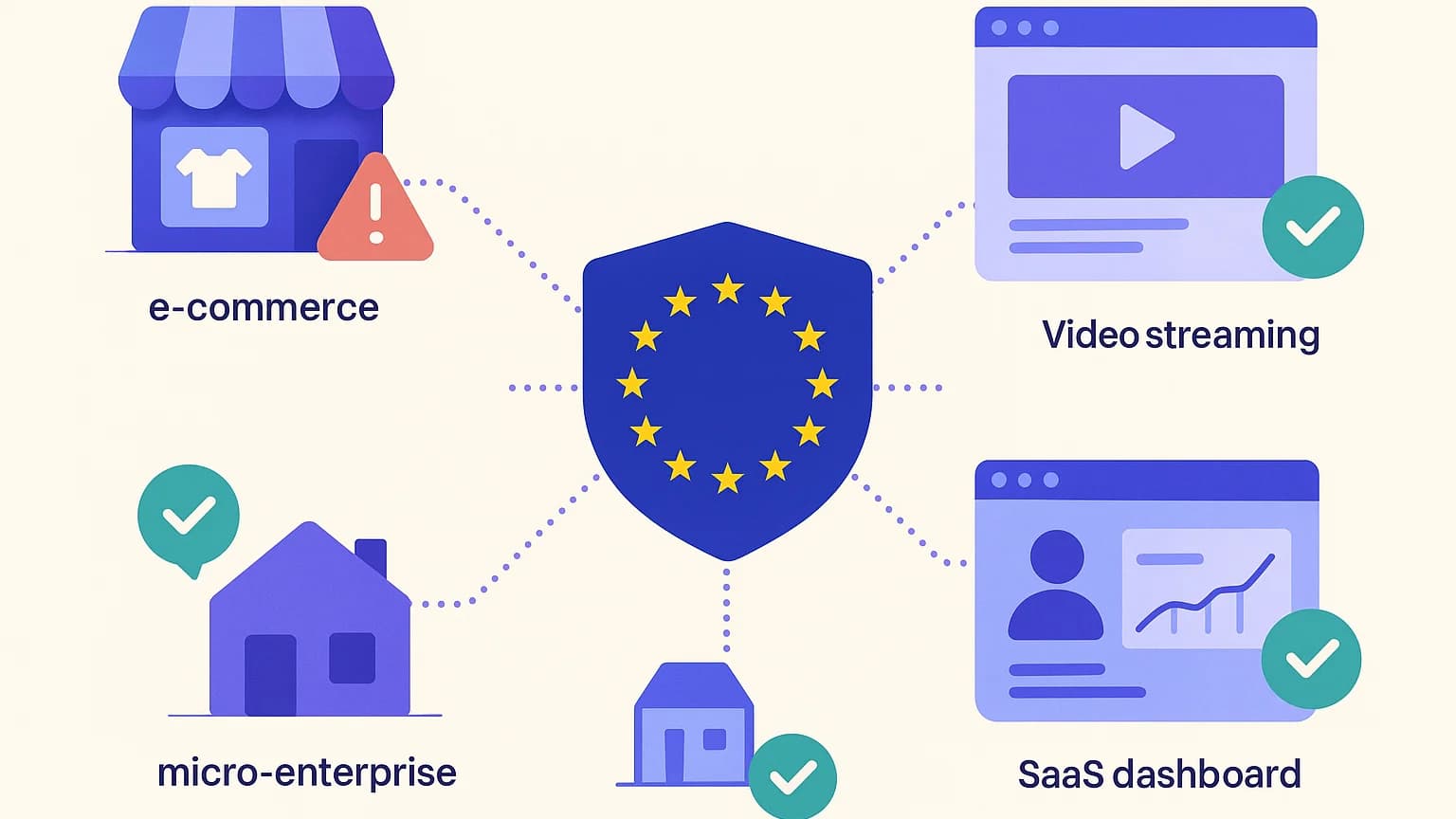
The EAA's scope is broader than many businesses realize.
You're affected if:
- You sell products or services to consumers in the EU (even from outside the EU)
- You publish videos tied to a service: ads, product tutorials, customer training, webinars
- You're a broadcaster, streaming platform, or media company
- You provide e-commerce services with video content
You're exempt if:
- You're a micro-enterprise: fewer than 10 employees AND annual turnover below EUR 2 million (Closed Caption Creator, 2025)
- Compliance would impose a disproportionate burden (must be documented and justified to the relevant authority)
Watch out for gray areas. Independent content creators aren't directly targeted. But if you work with brands, agencies, or B2B clients subject to the EAA, your deliverables must comply. A social media manager producing videos for an e-commerce brand is effectively in scope. Check our social media manager guide for workflow adjustments.
The EAA also applies to non-EU companies selling into the EU. If your SaaS has European customers and you publish webinars or tutorial videos, you need captions.
Sources
- Micro-enterprises exempt: fewer than 10 employees and under EUR 2 million annual turnover — Closed Caption Creator (2025)
Penalties by country: what non-compliance actually costs
The EAA is a European directive, meaning each member state transposed penalties into national law. The amounts vary dramatically.
In France, the DGCCRF handles enforcement. Fines can reach EUR 300,000 cumulative (daily penalties of EUR 3,000). A EUR 50,000 fine applies for non-compliance with accessibility obligations for communication services, renewable every 6 months. An additional EUR 25,000 is imposed for failing to publish an accessibility statement (Onepoint, 2025).
In Germany, fines reach up to EUR 100,000 per non-compliant product or service (3Play Media, 2025). Sweden caps penalties at EUR 200,000 with mandatory corrective actions. Ireland provides for up to EUR 60,000 and/or 18 months imprisonment. Italy applies fines ranging from EUR 5,000 to EUR 40,000 or up to 5% of annual revenue.
Beyond fines, some countries can ban non-compliant products or services from the market and require regular compliance reports.
The math is straightforward: non-compliance costs far more than compliance ever will.
| Country | Maximum fine | Additional penalties |
|---|---|---|
| France | EUR 300,000 (cumulative) | Market ban + daily penalties |
| Germany | EUR 100,000 / product | Mandatory corrective actions |
| Sweden | EUR 200,000 | Mandatory corrective actions |
| Ireland | EUR 60,000 | Up to 18 months imprisonment |
| Italy | 5% of revenue or EUR 40,000 | Service suspension possible |
Sources
- France: fines up to EUR 300,000 cumulative, EUR 50,000 renewable every 6 months, EUR 25,000 for missing accessibility statement — Onepoint / French Government (2025)
- Germany: up to EUR 100,000 per non-compliant product — 3Play Media (2025)
- Sweden: up to EUR 200,000; Ireland: EUR 60,000 and/or 18 months prison; Italy: up to 5% of revenue — Limecraft / 3Play Media (2025)
How to make your videos EAA-compliant in 2026
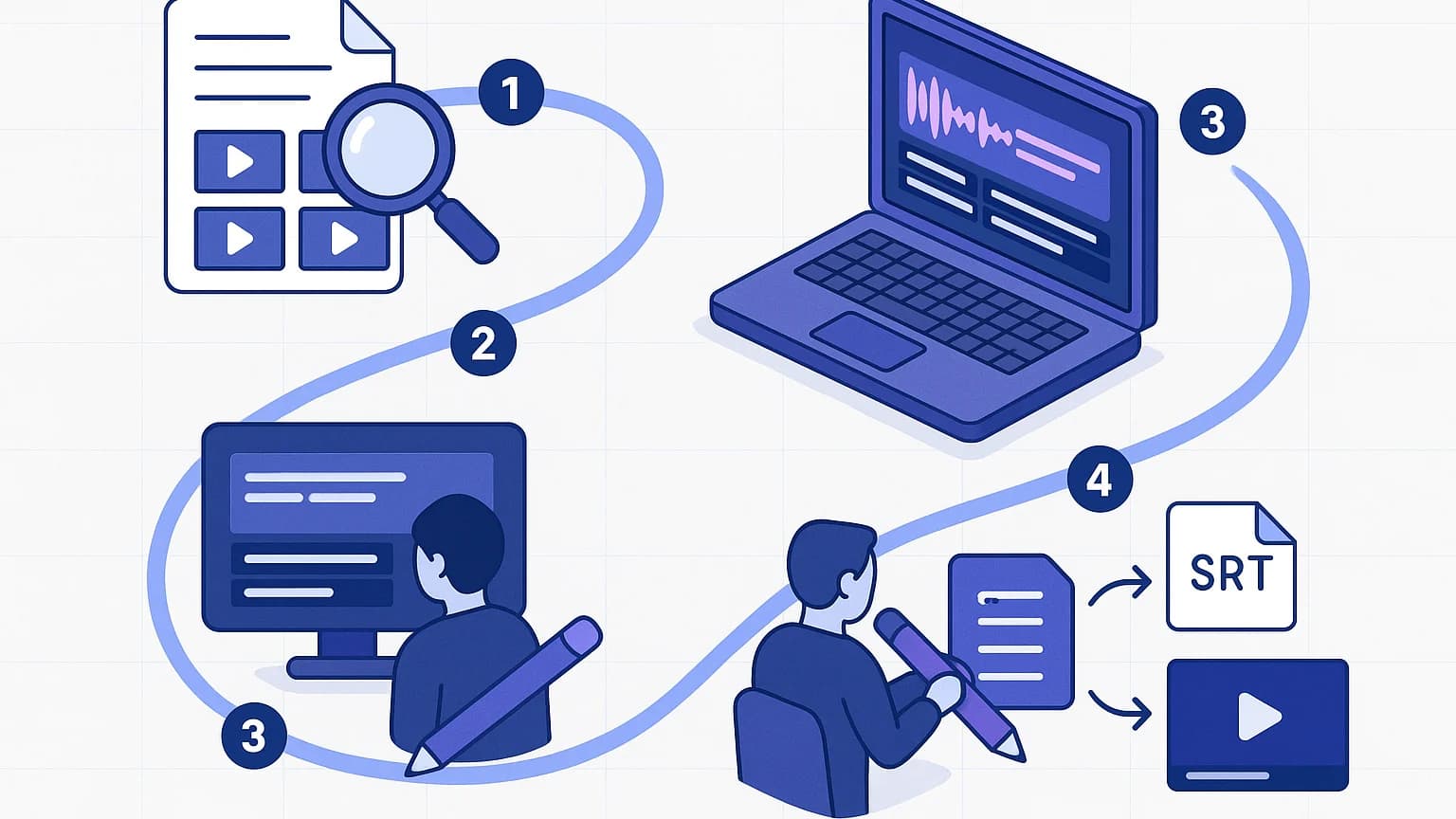
The good news: getting compliant has never been easier or more affordable. Here's the 4-step workflow.
1. Audit your existing video content. List every video published on your website, social media, and training platforms. Identify those with no captions or only unreviewed auto-generated captions. That's your accessibility debt.
2. Generate high-accuracy AI captions. YouTube's auto-generated captions are only about 70% accurate (Social Media Today, 2025). That's not EAA-compliant. Use an AI subtitle tool that reaches 95-98% accuracy. MagicClip generates word-by-word synchronized captions — a precision level the EAA recognizes as compliant.
3. Review and correct. Even at 95% accuracy, errors remain. Proper nouns, technical jargon, and idiomatic expressions are AI's weak spots. Budget 10-15 minutes of review per 10 minutes of video. That's 30-50% faster than writing captions from scratch (SDL/TAUS Research).
4. Export and publish. Export as SRT (most universal) or WebVTT (preferred for web). Upload files to each platform. For YouTube, use YouTube Studio > Subtitles. For webinars, embed VTT files in your video player.
Estimated cost: AI captioning averages USD 0.12 per second of video (Technology Org, 2025). Captioning 10 minutes costs roughly USD 7 — less than 0.02% of the minimum fine in France.
Sources
- YouTube auto-generated captions are about 70% accurate — Social Media Today (2025)
- Post-editing AI is 30-50% faster than translating from scratch — SDL/RWS Research, TAUS (2024)
- AI captioning cost: USD 0.12/second on average — Technology Org (2025)
Auto-generated vs professional captions: what quality level does the EAA demand?
The question everyone asks: are AI-generated captions good enough for compliance?
Short answer: yes, if you review them.
The EAA demands captions that are "high quality, synchronized and faithful to spoken content." It doesn't prescribe a method — it defines an outcome. Whether your captions are AI-generated, human-written, or professionally transcribed, it's the result quality that matters.
Specialized AI tools achieve 95-98% accuracy for common languages (Robin Waite, 2026). After a 10-15 minute review, you reach compliant quality. By comparison, YouTube's auto-captions at 70% accuracy are not compliant without substantial correction.
EAA quality criteria for captions:
- Fidelity: text reflects spoken content, including relevant sound cues (music, significant background noise)
- Synchronization: maximum tolerated delay of a few hundred milliseconds
- Readability: appropriate reading speed, correct sentence segmentation
- Completeness: all essential spoken content is covered
For businesses producing high volumes of content (training programs, weekly webinars), the optimal workflow is clear: AI generation + human review. The localization industry calls this the hybrid workflow, and it's the 2026 standard.
Modern AI video editing tools now integrate caption generation directly into the editing flow, eliminating manual import/export steps.
Sources
- Specialized AI tools achieve 95-98% accuracy for common languages — Robin Waite (2026)
Video accessibility as a growth lever, not just a legal box
Captioning your videos for EAA compliance isn't just a legal obligation. It's an investment with measurable returns.
Captioned videos are watched to completion by 91% of viewers, vs 66% without captions (Verizon Media, 2019). 75-85% of users watch videos without sound — in transit, at the office, or scrolling social feeds.
Adding captions boosts views by +13.48% within 2 weeks (3Play Media). Long-term, the increase can reach +80% thanks to search engine indexation of caption text (PLYMedia / Amberscript).
In 2026, the AI video localization market reaches USD 7.4 billion (Grand View Research). That's no coincidence: businesses understand that accessibility and growth are two sides of the same coin.
And if you go further by translating your subtitles into other languages, each linguistic market becomes a new acquisition channel. On YouTube, 25% of watch time for some creators comes from non-primary languages (YouTube Blog, 2026).
EAA compliance is the floor. Multilingual accessibility is the competitive edge.
Sources
- 91% of viewers watch captioned videos to completion vs 66% without — Verizon Media / Publicis Media (2019)
- +13.48% views within 2 weeks after adding captions — 3Play Media (2024)
- +80% views long-term with captions — PLYMedia / Amberscript (2024)
- AI video localization market: USD 7.4 billion — Grand View Research / Keevx (2026)
- 25% of YouTube watch time from non-primary languages — YouTube Blog (2026)